Structural engineers are working to determine what caused the partial structural failure that halted construction at the former Pfizer headquarters redevelopment in Midtown Manhattan, one of the largest office-to-residential conversion projects in the United States.
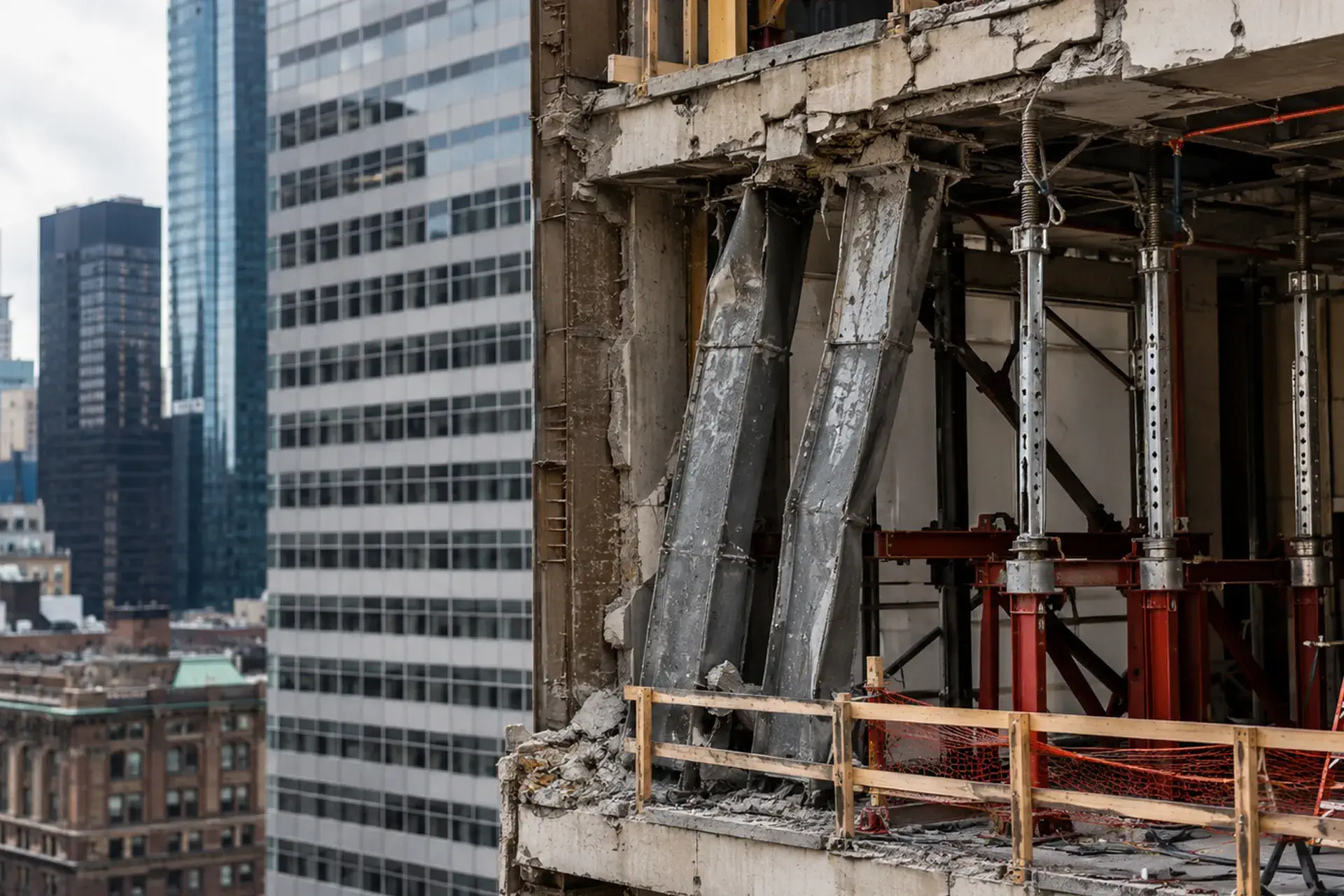
Emergency stabilization work was completed after two load-bearing columns buckled on the building’s 21st floor, allowing investigators to shift their attention from securing the structure to identifying the cause of the incident.
City officials have emphasized that the investigation remains in its early stages and cautioned against drawing conclusions until engineers complete a comprehensive review.
Investigation focuses on design, construction and site conditions
The structural failure occurred during the conversion of the former Pfizer headquarters at 235 East 42nd Street, where developers are transforming the office tower into approximately 1.3 million square feet of residential space, including more than 1,600 apartments and an 11-story vertical expansion.
According to New York City Department of Buildings Commissioner Ahmed Tigani, the project underwent extensive structural reviews before construction began. Investigators are now examining whether the failure resulted from design issues, construction sequencing, temporary loading conditions or another factor.
Structural engineers say determining the exact cause will require months of technical analysis.
Engineers reconstruct events leading to failure
Experts involved in previous high-profile structural investigations say the first step is understanding the building’s condition immediately before the columns buckled.
Investigators are expected to review:
- Original structural drawings
- Shop drawings and fabrication records
- Temporary shoring and construction sequencing plans
- Recent structural modifications
- Contractor daily reports
- Inspection records
- Photographs and laser scans of the damaged area
By comparing the original design with actual field conditions, engineers hope to reconstruct the sequence of events that led to the structural distress.
Existing buildings present unique challenges
Unlike new construction, adaptive reuse projects require engineers to evaluate decades-old structures whose existing conditions may differ from historical drawings.
Structural specialists note that renovations often uncover changes made over the life of a building, requiring continuous verification throughout construction.
Engineers must determine whether the original structural system matched available documentation and whether ongoing construction altered load paths in unexpected ways.
Damage assessment extends beyond visible columns
Experts caution that visibly buckled columns may represent only part of the damage.
Because structural systems distribute loads throughout the building, investigators will evaluate surrounding beams, slabs, columns and connections to determine whether additional elements experienced excessive stress after the initial failure.
The building has been stabilized using temporary steel shoring while engineers continue detailed inspections and structural monitoring.
Advanced surveying equipment and movement sensors are expected to play a key role in confirming the building remains stable throughout the investigation.
Engineering and legal reviews proceed simultaneously
Construction attorneys say technical investigations are typically accompanied by legal and insurance reviews almost immediately after a major structural incident.
Project participants—including owners, contractors, engineers, architects and insurers—are expected to preserve project documentation such as contracts, inspection reports, Building Information Modeling (BIM) files, photographs and correspondence while conducting independent evaluations.
Industry experts note that preserving evidence is critical because repairs and stabilization efforts can alter conditions at the site.
Answers likely months away
Structural engineers familiar with major building failures say identifying a definitive cause requires patience.
Investigators must analyze engineering calculations, construction records, material performance, site conditions and witness accounts before reaching conclusions.
Only after completing that technical review will engineers be able to determine whether the incident resulted from design deficiencies, construction practices, temporary loading conditions or a combination of factors.
Experts also expect the findings to influence future adaptive reuse projects, as office-to-residential conversions continue to grow across major U.S. cities.
For now, the Manhattan redevelopment remains on hold while investigators work to answer the central question: what caused the structural failure, and how can similar incidents be prevented in future projects?