
The Airport Asphalt Pavement Technology Program (AAPTP) has released two new research reports aimed at improving the performance, safety, and longevity of asphalt pavements at airports across the United States.
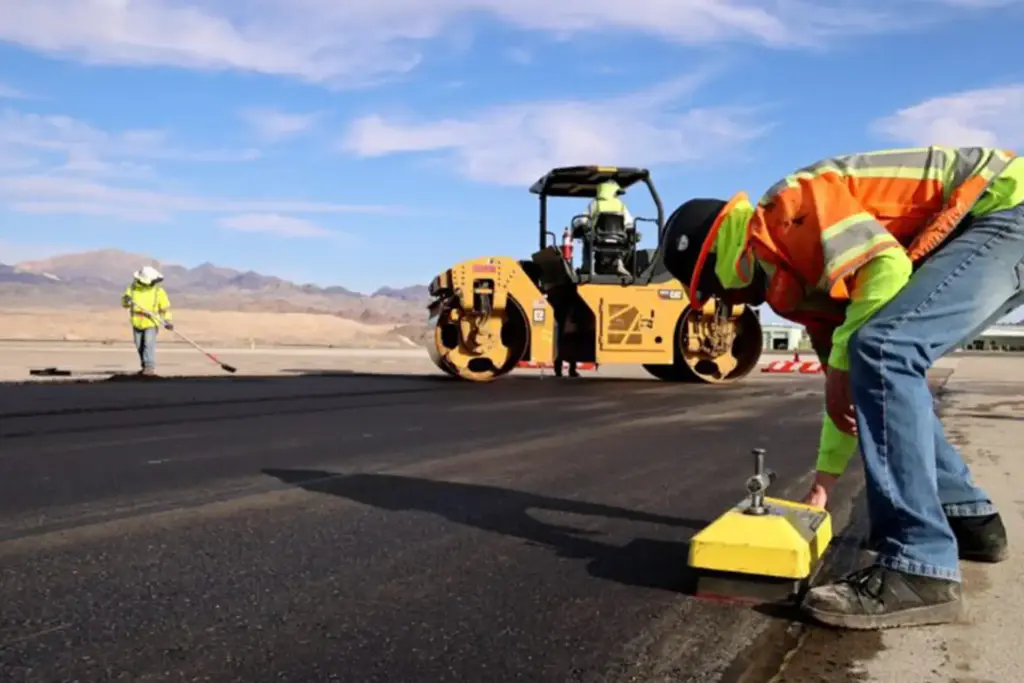
The studies provide updated technical guidance for engineers, airport authorities, and contractors, focusing on asphalt mix design and the prevention of pavement failures in high-stress airfield environments.
Together, the reports offer practical tools to support better testing, design, and construction practices for airport infrastructure.
Study validates asphalt compaction methods
One of the newly released studies confirms that both the traditional Marshall hammer and the Superpave Gyratory Compactor (SGC) can produce comparable results for airport asphalt mix designs.
The findings provide agencies and contractors with greater flexibility when selecting compaction methods and offer a reliable framework for organizations transitioning from older equipment to newer technologies.
The research was conducted by teams from the National Center for Asphalt Technology (NCAT) at Auburn University and the University of Nevada, Reno in support of Federal Aviation Administration (FAA) pavement requirements.
According to Dr. Richard Willis, NAPA’s Vice President of Engineering, Research, and Technology, the goal was to establish a dependable baseline that would allow engineers to confidently use either compaction method while maintaining consistent design results.
The study is expected to help streamline airport pavement design processes while ensuring compliance with FAA specifications.
Research targets runway pavement failures
A second report examines the causes of pavement slippage failures commonly found near high-speed runway exits, where aircraft transition rapidly from landing speeds to taxiing operations.
These areas are subjected to intense braking forces and shear stresses, making them particularly vulnerable to pavement distress.
Researchers identified several contributing factors, including:
- Weak bonding between pavement layers
- Unstable asphalt mixtures
- Temperature-related performance issues
- Construction quality concerns
- Excessive shear stresses
The study provides engineers with improved tools for evaluating pavement performance and reducing the risk of future failures.
Research was conducted by teams from Rutgers University, NCAT, and Arizona State University.
Dr. Hao Wang, a professor of civil and environmental engineering at Rutgers University, said the project provided an opportunity to apply engineering research to real-world aviation challenges.
The findings are expected to support safer and more durable runway infrastructure at airports nationwide.
Expanding knowledge across the industry
The research is part of AAPTP’s broader effort to improve understanding of asphalt pavement design, construction, and long-term performance.
In addition to technical studies, AAPTP has partnered with Applied Research Associates (ARA) and industry stakeholders to document best practices used throughout the asphalt pavement sector.
That initiative has included thousands of research hours, extensive industry collaboration, and the development of educational resources such as articles, videos, and technical guidance documents.
Industry leaders say these efforts help translate complex engineering concepts into practical solutions that improve infrastructure quality while supporting safer and more efficient airport operations.